
Research
Research and Resources
Research leads to greater understanding and exciting discoveries.
Research leads to greater understanding and exciting discoveries. Information about our geological heritage is being gathered all the time and we’re always keen to celebrate new findings and outcomes. As well as broadening our knowledge of the Geopark, research helps to build a sense of pride in this special place.
Fossil find at Saltern Cove
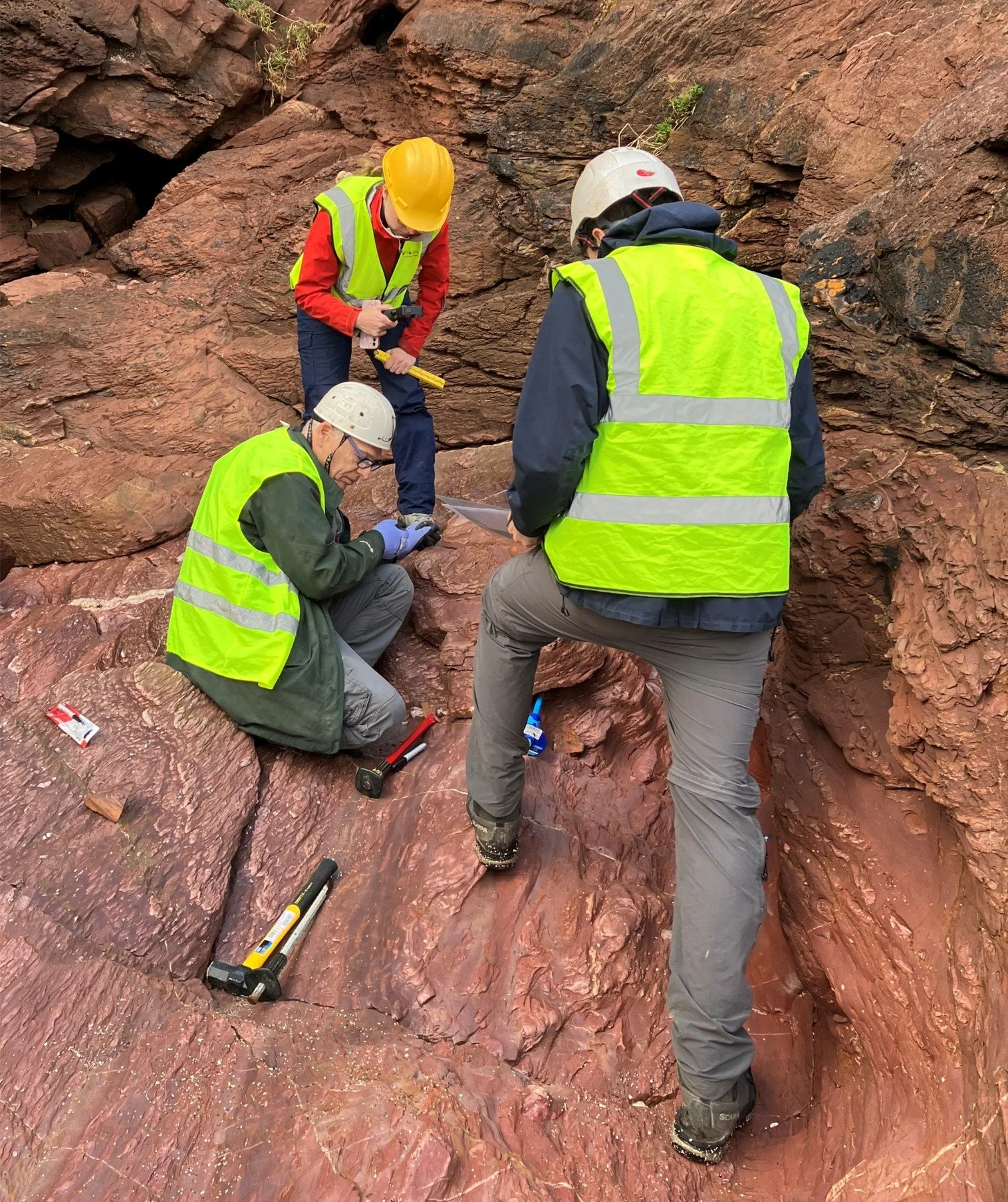
In December 2024, the English Riviera UNESCO Global Geopark announced a groundbreaking fossil discovery at Saltern Cove. The fossils were of trees and believed to be around 377 million years old. They were discovered by Dr Kevin Page during a condition survey of the Geopark’s Sites of Special Scientific Interest for Natural England. Dr Page is President of ProGEO and Honorary Senior Research Fellow at Camborne School of Mines, University of Exeter.
The fossils, identified as pieces of roots and bark belonging to primitive trees known as ‘lycopsids’, provide a unique glimpse into the ancient landscape of Torbay. Looking like our palm trees of today, these early, simple trees were the ancestors of the giant trees that once contributed to coal formation — though they are believed to have reached heights of just four metres. This find could potentially be the first record of a Devonian desert island with trees. The fossils are housed at Torquay Museum and will undergo academic study and preparation.
Carrying out research in the Geopark
Formal academic research in the Geopark is encouraged, and consent processes apply: all geological sites within the Geopark are protected by law, and the collection of geological specimens is not permitted without formal consent from the relevant authorities and site owners. To discuss a research proposal, contact the Geopark.
Universities and independent research organisations can also partner with the Geopark as a “Living Lab” — see Post-secondary Education.